

Your lab report is due, and the reference list still looks wrong. ACS style wants surnames first, semicolons between authors, a bold year, an italic volume and a DOI at the end. One slip can cost marks or send a manuscript back.
This free ACS citation generator builds each reference from the current ACS Style Quick Guide and numbers your list for you. Below the tool, you will find every rule with real examples.
What Is an ACS Citation Generator?
A free online ACS citation tool turns the details of a source into a reference in American Chemical Society style. You paste a DOI, a link or an ISBN, or you fill in a form. The ACS citation generator then writes the numbered reference and the matching in-text citation.
Some students search for an American Chemical Society citation generator or an ACS reference generator. They mean the same thing. The style belongs to the American Chemical Society, the group behind ACS Publications and journals such as the Journal of the American Chemical Society.
How Do You Use This ACS Citation Generator?
Paste a DOI, URL, ISBN or arXiv ID into the search box at the top and press Cite. This ACS citation generator finds the source, fills in the form and shows the reference as you type. Check the fields, then click “Add to reference list” and repeat for each source.
- Find the source. Paste an identifier, or type a title and pick the right match. Crossref, DataCite and Open Library supply the details.
- Pick the source type if it needs changing. There are 14, from journal article and website to patent, standard and dataset.
- Check the form. Fix capital letters, add missing pages, or add an article number when there are no page numbers.
- Set your options. Under the preview, tick the CASSI box for short journal names, switch in-text numbers from superscript to (1), or list every author.
- Add it to your list. The tool numbers each source in the order you add it. Drag entries to change the order.
- Copy or export. Copy the list with italics and bold intact, or download a Word file, a BibTeX file for LaTeX, or an RIS file for Zotero, Mendeley and EndNote.
Your list stays in your browser. Nothing goes to our server.
What Makes This ACS Citation Generator Different?
This ACS citation generator follows the latest ACS Style Quick Guide, including the recent rule changes that many free tools still miss. It covers 14 source types, matches each grey example to the official guide, and needs no account. Abbreviations, access dates and author limits are options, not guesses.
- Current rules. Full journal names by default, no publisher city unless you add one, no “In” before book titles, and each DOI as a working link.
- Chemistry sources. Patents, standards, technical reports, datasets, software, ChemRxiv and arXiv preprints and conference abstracts each get their own form.
- CASSI on request. Tick one box and “Journal of the American Chemical Society” becomes “J. Am. Chem. Soc.”
- Small details done right. It drops a leading “The” from journal names, keeps “Science” whole, handles articles ASAP that have no volume yet, and strips commas from patent numbers.
- Tested output. We checked the formatter against 45 worked examples, most copied from the ACS Style Quick Guide.
How Does ACS Citation Style Work?
ACS citation style is a numbered system. Each source gets a number the first time you cite it, shown as a superscript or in parentheses, and that number stays with the source for the whole paper. The reference list at the end shows every source in number order, not alphabetical order.
The rules come from The ACS Guide to Scholarly Communication, the society’s current style manual. It replaced the older ACS Style Guide, which many older tools still quote. Its free ACS Style Quick Guide shows a worked example for each common source, and the tool on this page follows it.
Learning how to cite in ACS style starts with three ideas:
- Numbers, not names. The reader sees a small raised 4 and finds entry (4) in the list.
- Order of first citation. The first source you cite is 1, the next new source is 2, and so on.
- One number per source. When you cite a source again, you reuse its first number.
Chemistry, biochemistry, chemical engineering and materials science courses use ACS style most. If your instructor names ACS, this is the format they expect.
How Do You Write ACS In-Text Citations?
Put the reference number in superscript right after the fact you cite, or in parentheses on the line, such as (3). Pick one form and keep it for the whole paper. A superscript goes after punctuation with no space; a number in parentheses goes before the period.
| Situation | Superscript | Parentheses |
|---|---|---|
| One source | …in water.3 | …in water (3). |
| Two sources | …in earlier work.2,5 | …in earlier work (2, 5). |
| A run of three or more | 7–12, with an en dash | (7–12) |
| A run plus single numbers | 4,7–10 | (4, 7–10) |
| Author named in the sentence | Cohen and co-workers6 showed… | Cohen and co-workers (6) showed… |
Every ACS in-text citation points to one numbered entry in your list. This ACS citation generator shows the right form under each preview.
Library guides disagree on one point. The UBC Library guide says ACS also allows an author-date form, while the UC San Diego guide says ACS does not use it. Numbers are the safe choice unless your instructor asks for author-date.
What Is the ACS Reference Format for Each Source Type?
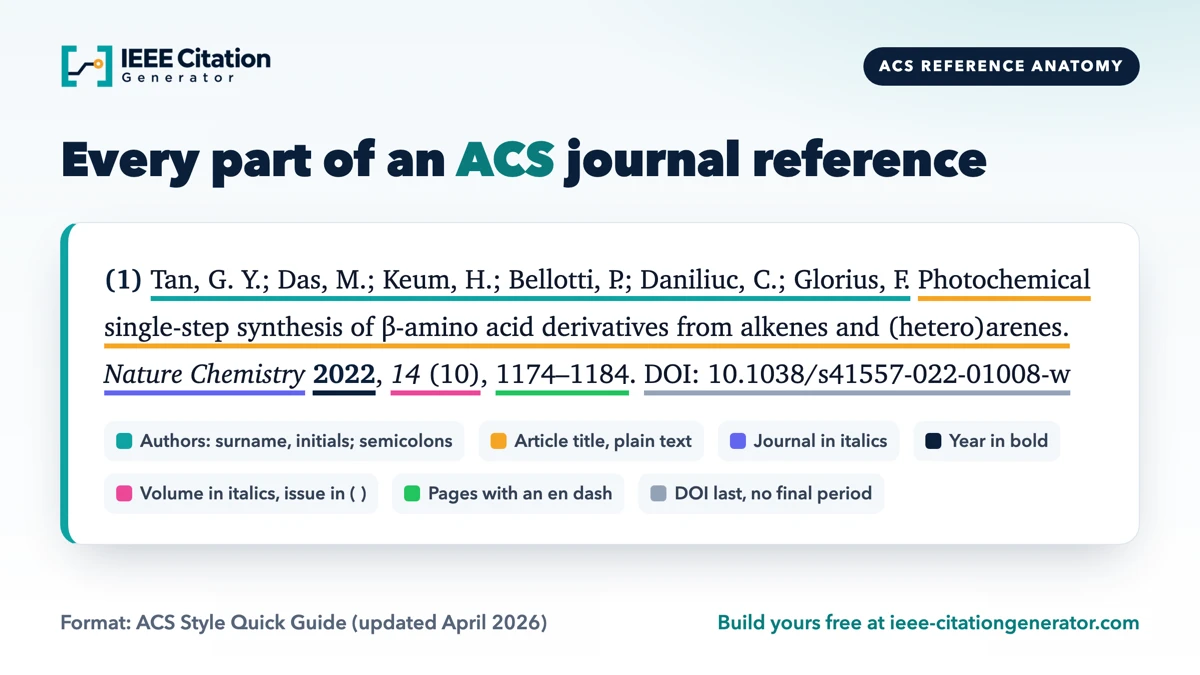
Every ACS reference starts with the authors, surname first, then the title, then the publication details. Journal names and book titles go in italics, article titles stay plain, and journal years go in bold. The table shows the pattern and a real example for the sources students cite most.
| Source type | ACS pattern | Example |
|---|---|---|
| Journal article | Author, A. A. Title. Journal Year, Volume (Issue), pages or article number. DOI: xxx | Westermayr, J.; Gastegger, M.; Schütt, K. T.; Maurer, R. J. Perspective on integrating machine learning into computational chemistry and materials science. Journal of Chemical Physics 2021, 154 (23), 230903. DOI: 10.1063/5.0047760 |
| Book | Author, A. A. Title, Nth ed.; Publisher, Year. DOI: xxx | Atkins, P. Concepts in Physical Chemistry, 2nd ed.; Royal Society of Chemistry, 2024. DOI: 10.1039/9781837674244 |
| Book chapter | Author, A. A. Title. Book Title, Nth ed.; Editor, A., Editor, B., Eds.; Publisher, Year; Vol. N, pp x–y. DOI: xxx | Birkel, C. S.; Hamm, C. M. Max phases and mxenes. Comprehensive Inorganic Chemistry III, 3rd ed.; Reedijk, J., Poeppelmeier, K. R., Eds.; Elsevier, 2023; Vol. 5, pp 278–289. DOI: 10.1016/B978-0-12-823144-9.00076-5 |
| Conference paper | Author, A. A. Title. Proceedings Title, City, Country, Dates; Editors, Eds.; Publisher: City, Year; Vol. N, pp x–y. DOI: xxx | Nilsson, A.; Petersson, F.; Persson, H. W.; Jönsson, H.; Laurell, T. Manipulation of Suspended Particles in a Laminar Flow. Micro Total Analysis Systems 2002, Proceedings of the μTAS 2002 Symposium, Nara, Japan, November 3–7, 2002; Baba, Y., Shoji, S., van den Berg, A., Eds.; Kluwer Academic: Dordrecht, The Netherlands, 2002; Vol. 2, pp 751–753. DOI: 10.1007/978-94-010-0504-3_50 |
| Website | Author, A. A. Page Title. Website Name, Month D, Year. URL | Brunning, A. National Tea Day: What causes the scum on tea? Compound Interest, April 23, 2023. https://www.compoundchem.com/2023/04/21/tea/ |
| Thesis | Author, A. A. Title. Ph.D. Thesis, University, Year. URL | Tsien, R. Y. The Design and Use of Organic Chemical Tools in Cellular Physiology. Ph.D. Thesis, University of Cambridge, 1976. |
| Technical report | Author, A. A. Title, Report No.; Organization: City, ST, Year. URL | Hung, C.-C.; Hurst, J.; Santiago, D. Boron Nitride Nanoribbons from Exfoliation of Boron Nitride Nanotubes, NASA/TM-2017-219455; National Aeronautics and Space Administration, Glenn Research Center: Cleveland, OH, 2017. https://ntrs.nasa.gov/search.jsp?R=2017000388 |
| Patent | Inventor, A. A. Title. Country code, number and kind code, Year. | Lois-Caballe, C.; Baltimore, D.; Qin, X.-F. Method for Expression of Small RNA Molecules within a Cell. US7732193B2, 2010. |
| Standard | Organization. Title, Standard No.; City, ST, Year. DOI: xxx | ASTM International. Standard Test Method for Tensile Properties of Plastics, ASTM D638-14; West Conshohocken, PA, 2014. DOI: 10.1520/D0638-14 |
| Preprint | Author, A. A. Title, Ver. N. Server, Month D, Year. DOI: xxx | Deysher, G.; Oh, J. A. S.; Chen, Y.-T.; Sayahpour, B.; Ham, S.-Y.; Cheng, D.; Ridley, P.; Cronk, A.; Lin, S. W.-H.; Qian, K.; et al. An Anode-Free Sodium All-Solid-State Battery, Ver. 1. ChemRxiv, November 23, 2023. DOI: 10.26434/chemrxiv-2023-tkcd9 |
| Dataset | Author, A. A. Title (Dataset). Repository, Month D, Year. DOI: xxx | Cappa, C.; Li, Z.; Smith, K. Influence of Relative Humidity on the Heterogeneous Oxidation of Secondary Organic Aerosol (Dataset). Dryad, May 18, 2018. DOI: 10.25338/B8ZK5X |
| Software | Author. Name, Ver. N; Publisher, Year. URL | Mathematica, Ver. 14; Wolfram Research, 2024. |
| Online video | Creator. Title. Organization. Platform, Date. URL | Swartz, G. The Water of Life: A Whisky Story. Giant Pictures. Kanopy, 2022. https://www.kanopy.com/en/product/water-life-whisky-film |
The ACS citation format changes a little from one source type to the next. Pick a type in the tool above and the form asks only for the fields that type needs.
How Do You Format Author Names in ACS Style?
Write the surname first, then a comma and the initials with periods: “Glorius, F.” Separate authors with semicolons and end the list with a period. List up to 10 authors; for more than 10, ACS lists the first 10, then a semicolon and “et al.”
- Middle names become initials with a space: Kristof T. Schütt is “Schütt, K. T.”
- Hyphenated first names keep the hyphen: Yu-Hwa Lo is “Lo, Y.-H.”
- Suffixes follow the initials after a comma: “Merz, K. M., Jr.”
- Organizations appear in full where a person’s name would go.
- Editors take commas, not semicolons, and end with “Ed.” or “Eds.”: “Reedijk, J., Poeppelmeier, K. R., Eds.”
Type full first names into the ACS citation generator and it turns them into initials. If your instructor wants every name on a long author list, tick “List every author” under the preview.
What Changed in the Latest ACS Formatting Rules?
The latest update to the ACS references chapter changed five rules. Journal names may now be full or abbreviated, access dates matter only for undated web pages, patent numbers lose their commas, each DOI should be a link, and article titles can keep the capitals the source uses.
ACS announced the changes on its Axial publishing blog, and a later update refreshed the book examples. The ACS citation generator on this page follows both.
| What changed | What to do now |
|---|---|
| Journal names | Write them in full or abbreviate them, but use one form for the whole list |
| Access dates | Add “(accessed YYYY-MM-DD)” only to undated pages that may change |
| Patent numbers | Drop the commas: US7732193B2, not 7,732,193 |
| DOIs | Keep “DOI: 10.xxxx” and make the DOI a working link |
| Article titles | Keep the capital letters the source prints |
Some rules stayed the same. The journal year is still bold, the volume is still italic, and page ranges take an en dash. Books and chapters use “pp” with no period.
Should You Abbreviate Journal Names?
Abbreviate only if your instructor or target journal asks, and then shorten every journal the same way. ACS takes its journal abbreviations from the CAS Source Index, known as CASSI. You can look up any title in the free CASSI search tool from CAS, a division of the American Chemical Society.
| Full journal name | CASSI abbreviation |
|---|---|
| Journal of the American Chemical Society | J. Am. Chem. Soc. |
| Nature Chemistry | Nat. Chem. |
| Journal of Physical Chemistry A | J. Phys. Chem. A |
| Environmental Science & Technology | Environ. Sci. Technol. |
| Angewandte Chemie International Edition | Angew. Chem., Int. Ed. |
| Science | Science (one-word titles stay whole) |
How Do You Cite DOIs, URLs and Online Sources in ACS?
End the reference with “DOI:” and the DOI, with no period after it, and make the DOI a link. When a source has no DOI, end with its URL instead. Add “(accessed YYYY-MM-DD)” after the URL only when the page has no date and may change, such as Wikipedia or a homepage.
A DOI (digital object identifier) is a permanent ID for an article, book or dataset. You find it on the first page of a paper or on the publisher’s page. Crossref and DataCite register DOIs, and publishers keep each one pointing at the right page, so it outlasts a normal link.
- Journal article with a DOI: no URL and no access date.
- Undated web page: “Oganesson. Wikipedia.” then the URL and “(accessed 2024-04-21)”.
- Preprint: the server name in italics, the posting date, then the DOI. arXiv IDs turn into DOIs that start with 10.48550.
The tool adds the access date to undated pages for you. If your instructor wants it on every online source, tick the access-date box.
How Should an ACS Reference List Look?
Title the list “References” and put it at the end of your paper. List each source once, in the order you first cite it, with its number in parentheses, such as (1), at the start. Use the same font size as your text, not superscript numbers.
Some course handouts number the list “1.” instead, so follow your instructor if they show one. Before you hand in your work, run through these checks:
- Every number in your text has a matching entry, and you cite every entry.
- Numbers run in order of first citation with no gaps.
- Journal names are all full or all abbreviated, never mixed.
- Each source appears once and keeps one number.
The tool handles the numbering. Drag entries to reorder them if you change your text, and the numbers update at once.
ACS vs IEEE vs APA: What Is the Difference?
ACS and IEEE are both numbered styles, but ACS puts surnames first and bolds the journal year, while IEEE puts initials first and abbreviates journal names. APA uses the author and year in parentheses and an alphabetical list. Chemistry favors ACS, engineering favors IEEE and psychology favors APA.
| Feature | ACS | IEEE | APA 7 |
|---|---|---|---|
| In-text citation | Superscript 1 or (1) | [1] | (LeCun et al., 2015) |
| List order | Order of first citation | Order of first citation | Alphabetical by author |
| Year | Bold, after the journal name | Near the end, with the month | In parentheses after the authors |
| Journal names | Full or CASSI abbreviated | Abbreviated | Full |
| Same article | LeCun, Y.; Bengio, Y.; Hinton, G. Deep learning. Nature 2015, 521 (7553), 436–444. DOI: 10.1038/nature14539 | Y. LeCun, Y. Bengio, and G. Hinton, “Deep learning,” Nature, vol. 521, no. 7553, pp. 436–444, May 2015, doi: 10.1038/nature14539. | LeCun, Y., Bengio, Y., & Hinton, G. (2015). Deep learning. Nature, 521(7553), 436–444. https://doi.org/10.1038/nature14539 |
Writing for an engineering course instead? Use our free IEEE citation generator on the homepage. Paste the same DOI there and you get the IEEE version in seconds.
What Are the Most Common ACS Citation Mistakes?
The most common slips are initials before surnames, commas between authors instead of semicolons, a plain year instead of a bold one, mixed full and abbreviated journal names, and hyphens in page ranges. Each one is easy to miss by hand, and the ACS citation generator prevents all of them.
- Following an old guide. Rules from the older ACS Style Guide still circulate.
- Sorting the list alphabetically. ACS numbers sources in the order you cite them.
- Italic article titles. Article titles stay in plain text.
- “pp.” with a period. Books and chapters use “pp 599–652”.
- Leaving out the DOI when the source has one.
- Adding the publisher’s city by habit. Give a location only when it helps a reader find the publisher.
Frequently Asked Questions About the ACS Citation Generator
Is this ACS citation generator free?
Yes. This ACS citation generator is completely free, with no account, no trial and no limit on references. Every export costs nothing too.
How do I cite a website in ACS style?
Write the author, the page title, the website name in italics and the date, then the URL. If the page has no date, add “(accessed YYYY-MM-DD)” after the URL.
Should ACS in-text citations be superscript or in parentheses?
Either works. ACS journals print superscript numbers in their PDFs and numbers in parentheses on their web pages. Pick one form and use it for the whole paper.
Do you have to abbreviate journal names in ACS?
No. Since the latest update, ACS accepts full or abbreviated journal names, as long as one list uses one form.
When does ACS use “et al.” in a reference?
When a source has more than 10 authors. List the first 10, add a semicolon, then “et al.” Some instructors want every author, and the tool has a switch for that.
Can I export ACS references to Word, LaTeX or Zotero?
Yes. Copy the list into Word or Google Docs, or download a .doc file. BibTeX export works with LaTeX, and RIS export works with Zotero, Mendeley and EndNote.
Start Your ACS Reference List Now
Clean references show care, and they take seconds with the right tool. Scroll back to the ACS citation generator at the top, paste your first DOI, and build a numbered, export-ready list before your next lab session.
Written by Sara Whitfield, guides editor at IEEE Citation Generator. Sources: ACS Style Quick Guide, section 4.3.3 of The ACS Guide to Scholarly Communication (American Chemical Society); the ACS Axial announcement of the updates to the references chapter; and the CAS Source Index (CASSI) Search Tool.