

Your sociology paper is done, but the reference page is not. ASA puts the year right after the names, spells out first names and hangs the page number on a colon with no space. Copy APA habits into it, and the same mistake repeats in every entry and costs you marks.
This free ASA citation generator builds the reference and the in-text citation from one entry. Below it, each rule has a real example.
What Is an ASA Citation Generator?
It is a web tool that turns source details into American Sociological Association format. Paste a DOI, a link or an ISBN, or fill in a short form. The ASA citation generator then writes the reference list entry plus the matching author-date citation, with the right order, italics and punctuation.
The style comes from the ASA Style Guide, now in its seventh edition. The association wrote it for its own journals, and sociology departments then adopted it for student papers.
Some people search for an American Sociological Association citation generator, others for an ASA format generator. They want the same thing. One warning: agronomy also has an “ASA” style, and it follows different rules.
How Do You Use This ASA Citation Generator?
Paste a DOI, URL, ISBN or arXiv ID into the search box at the top and press Cite. The ASA citation generator looks up the source, fills in the form and shows the reference as you type. The in-text citation appears right under it, ready to copy into your paragraph.
- Find the source. Paste an identifier or a title. Crossref, DataCite and Open Library supply the details.
- Check the source type. Pick one of 16 tabs, from journal article and book chapter to podcast and court case.
- Fix the names. ASA wants full first names. Databases often store initials, so type the names the source prints.
- Add the page you cite. It lands after the colon in the in-text citation and leaves the reference untouched.
- Choose the citation form. Tick a box when you name the author in your sentence, or when you cite a three-author work again.
- Add it to your list and export. The tool sorts the list from A to Z. Copy it into Microsoft Word or Google Docs with the italics in place, or download a Word, BibTeX (LaTeX) or RIS file for Zotero, Mendeley and EndNote.
Your list stays in your browser, and you never need an account.
What Makes This ASA Citation Generator Different?
This ASA citation generator follows the seventh edition and the author instructions of the ASA’s own journals, and it handles the small print. Many free tools cover three source types, mix in older rules, or print a “Retrieved” date on every web page. Here, we tested each format, most of them against published examples.
- Both in-text forms. Get the citation in parentheses or with the author in the sentence, for first and later mentions.
- Page numbers the ASA way. The tool shortens 256–278 to 256–78 and knows when to keep every digit.
- Sociology sources. Datasets get a producer and a distributor. Census reports, dissertations, meeting papers, podcasts and posts have tabs of their own.
- Special years. Use the fields for “Forthcoming,” an original year in brackets, or the letters a, b and c.
- Journal switch. One tick box puts links in parentheses after “Retrieved,” as several ASA journals still show.
- Tested output. We checked the formatter against 107 cases. Of those, 36 come from the author instructions of ASA journals.
How Does ASA Style Work?
ASA is an author-date style. In your text you give the author’s last name and the year, with the page after a colon when you quote. At the end, a list headed “References” gives full details in A to Z order. Every in-text citation needs an entry there, and every entry needs a citation.
The ASA Style Guide, seventh edition is a printed book that the association calls the authoritative reference for work in its journals. It builds on The Chicago Manual of Style, so Chicago fills the gaps.
You don’t need the book for everyday sources. The association’s flagship journal, the American Sociological Review, prints the core rules and sample entries in its author instructions. So do the Journal of Health and Social Behavior, Social Psychology Quarterly and Teaching Sociology.
How Do You Write an ASA In-Text Citation?
Put the author’s last name and the year in parentheses, with no comma between them: (Gouldner 1963). If your sentence already names the author, put only the year in parentheses. For a quote or a specific passage, add a colon and the page with no space: (Ramirez and Weiss 1979:239–40).
| Situation | In parentheses | Author in the sentence |
|---|---|---|
| One author | (Mason 1974) | Mason (1974) |
| One author with a page | (Kuhn 1970:71) | Kuhn (1970:71) |
| Two authors | (Arum and Roksa 2011) | Arum and Roksa (2011) |
| Three authors, first citation | (Kalleberg, Reskin, and Hudson 2000) | Kalleberg, Reskin, and Hudson (2000) |
| Three authors, later citations | (Kalleberg et al. 2000) | Kalleberg et al. (2000) |
| Four or more authors | (Bianchi et al. 2012:57) | Bianchi et al. (2012:57) |
| Organization | (U.S. Bureau of the Census 1963:117) | U.S. Bureau of the Census (1963:117) |
| Same author, same year | (Goodman 1947a) | Goodman (1947a) |
| Reprinted work | (Veblen [1899] 1979) | Veblen ([1899] 1979) |
| Accepted, not yet published | (Szelényi and Olvera forthcoming) | Szelényi and Olvera (forthcoming) |
| No date | (United Nations, n.d.) | United Nations (n.d.) |
Separate several sources with semicolons, in alphabetical or date order: (Burgess 1968; Marwell et al. 1971). Pick one order and keep it through the whole paper.
An ASA in-text citation uses no ampersand and no “ibid.” Numbered styles work in a different way, as our guide to the bracketed numbers in IEEE in-text citations shows.
What Is the ASA Format for Each Source Type?
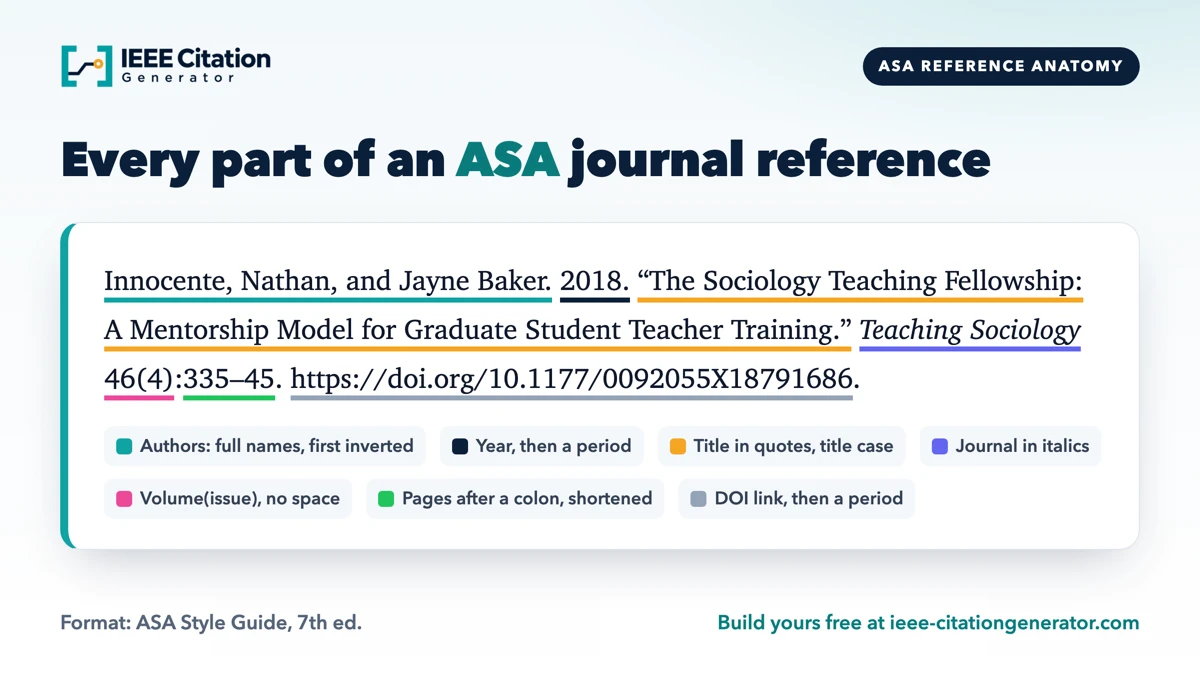
Every ASA reference runs in the same order, author, year, title, source, and a period closes each part. Article and chapter titles go in quotation marks, while books, journals and newspapers go in italics. The table gives each pattern with a real entry made by this ASA citation generator.
| Source type | Pattern | Example made with this tool |
|---|---|---|
| Journal article | Last, First, and First Last. Year. “Title.” Journal Volume(Issue):Pages. DOI link. | Innocente, Nathan, and Jayne Baker. 2018. “The Sociology Teaching Fellowship: A Mentorship Model for Graduate Student Teacher Training.” Teaching Sociology 46(4):335–45. https://doi.org/10.1177/0092055X18791686. |
| Book | Last, First. Year. Title. Place: Publisher. | Ngai, Mae M. 2004. Impossible Subjects: Illegal Aliens and the Making of Modern America. Princeton, NJ: Princeton University Press. |
| Edited book | Last, First, and First Last, eds. Year. Title. Place: Publisher. | Hagan, John, and Ruth D. Peterson, eds. 1995. Crime and Inequality. Stanford, CA: Stanford University Press. |
| Book, later edition | Last, First. Year. Title. Edition. Place: Publisher. | Corbin, Juliet, and Anselm Strauss. 2008. Basics of Qualitative Research. 3rd ed. Thousand Oaks, CA: Sage. |
| Book chapter | Last, First. Year. “Chapter.” Pp. Pages in Book, edited by F. Last. Place: Publisher. | Brown, Sandy, and Christy Getz. 2011. “Farmworker Food Insecurity and the Production of Hunger in California.” Pp. 121–46 in Cultivating Food Justice: Race, Class, and Sustainability, edited by A. H. Alkon and J. Agyeman. Cambridge, MA: MIT Press. |
| Website | Author or Organization. Year. “Page.” Site, Month Day. Place: Publisher. URL. | Aiken, Kristen. 2020. “The Best Vegetarian Instant Pot Recipes.” HuffPost, June 3. https://www.huffpost.com/entry/best-vegetarian-instant-pot-recipes_l_5e28b509c5b6d6767fce6c99. |
| Newspaper or magazine | Last, First. Year. “Article.” Newspaper, Month Day. URL. | Sampson, Robert J. 2006. “Open Doors Don’t Invite Criminals.” New York Times, March 11. https://www.nytimes.com/2006/03/11/opinion/11sampson.html. |
| Government report | Agency. Year. Title (Report number). Place: Publisher. | New York State Department of Labor. 1997. Annual Labor Area Report: New York City, Fiscal Year 1996 (BLMI Report, No. 28). Albany: New York State Department of Labor. |
| Dissertation | Last, First. Year. “Title.” PhD dissertation, Department, University, Place. | Charles, Maria. 1990. “Occupational Sex Segregation: A Log-Linear Analysis of Patterns in 25 Industrial Countries.” PhD dissertation, Department of Sociology, Stanford University, Stanford, CA. |
| Meeting paper | Last, First. Year. “Title.” Paper presented at the Meeting, Place, Month Day. | Richter, Lauren, and Grace Poudrier. 2021. “The Trouble with ‘Emerging Contaminants’: PFAS Ubiquity as Corporate Accomplishment.” Paper presented at the annual meeting of the American Sociological Association, virtual, August 9. |
| Dataset | Author. Year. Title [Computer file]. Study number. Place: Archive [distributor]. DOI link. | Deschenes, Elizabeth Piper, Susan Turner, and Joan Petersilia. 2000. Intensive Community Supervision in Minnesota, 1990–1992: A Dual Experiment in Prison Diversion and Enhanced Supervised Release [Computer file]. ICPSR06849-v1. Ann Arbor, MI: Inter-university Consortium for Political and Social Research [distributor]. https://doi.org/10.3886/ICPSR06849. |
| Online video | Speaker. Year. “Title.” Produced by Name, Month Day. Video, length. URL. | Edin, Kathryn. 2018. “One Misfortune Away.” Produced by the American Sociological Association, June 27. Video, 5:13. https://www.youtube.com/watch?v=ExmHMXPZ8Nc. |
| Podcast | Speaker. Year. “Episode.” Month Day in Show, produced by Name, podcast, length. URL. | Weinberg, Jill. 2017. “Jill Weinberg on Post-It Notes as a Visual Method.” March 18 in Give Methods a Chance, produced by Kyle Green and Sarah Lageson, podcast, 30:39. https://thesocietypages.org/methods/2017/03/18/jill-weinberg-on-post-it-notes-as-a-visual-method/. |
| Social media post | Name (@handle). Year. “Text of the post.” Platform, Month Day, time. URL. | Haag, Julius (@HaagJulius). 2020. “Consultation, consultation, consultation…there comes a point where this becomes an empty gesture.” Twitter, June 29, 2:47 p.m. https://twitter.com/HaagJulius/status/1277675055611330566. |
| Court case | Case name, volume reporter page (year). | Brown v. Board of Education, 347 U.S. 483 (1954). |
The ASA journals’ free pages skip software, preprints and published conference papers. For those, the tool uses the closest book, chapter or Chicago pattern. Films, laws and forthcoming work have their own tabs or tick boxes.
How Do You Write Author Names in ASA?
Write full first names, with middle initials when the source gives them. Invert only the first author: last name, comma, first name. Every other author keeps normal order, and the list names all of them. The ASA journals call “et al.” in a reference list “not acceptable.”
- One author: Mason, Karen O.
- Two authors: Innocente, Nathan, and Jayne Baker. Keep the comma before “and.”
- Three or more: Kalleberg, Arne L., Barbara F. Reskin, and Ken Hudson.
- Editors in place of authors: add “ed.” or “eds.” after the names.
- Editors of a book you cite a chapter from: use initials in normal order, as in “edited by J. McCord.”
- Organizations: write the name in full. If your text uses a short form, lead with it: WERA (World Education Research Association).
- No author on a web page: use the organization or site name. For an unsigned news story, use the newspaper’s name.
What Are the ASA Rules for Titles, Years and Page Numbers?
Use title case for every title. Put the year right after the authors, followed by a period. Give a journal’s volume, then its issue in parentheses, then a colon and the pages, with no spaces between them. Page ranges take an en dash and drop the digits that repeat.
- Title case: capitalize everything except articles, conjunctions and prepositions, unless they start the title. In a hyphenated word, capitalize only the first part, as in “Self-preservation,” unless the second part is a proper noun. The tool converts titles that databases store in sentence case.
- Years: write “n.d.” when there is no date and “Forthcoming” for accepted work. Put a reprint’s first year in brackets.
- Months: newspapers, posts, videos and meeting papers add the month and day after the source. Journals never do.
- Pages: keep every digit below 100, and after 100, 200 and so on. In other ranges, drop the digits that repeat: 209–10, 364–65, 596–628.
- Places: add the state abbreviation, as in “Princeton, NJ.” New York and other cities everyone knows stand alone.
Sources disagree on one point. Under the seventh edition’s page rule, 1394–1414 becomes 1394–414, yet several ASA journals still print a sample with all four digits, 1179–1259. The tool follows the manual, and one box prints every digit.
How Do You Cite a Website, DOI or URL in ASA?
End an online source with its DOI written as a link, or with the URL when there is no DOI. Then add a period. The seventh edition asks for an access date only when a source shows no date, so a dated web page gets none. Undated pages take “Accessed” plus the day you viewed them.
- ASA website citation with a date: organization, year, page title in quotation marks, URL.
- Website without a date: WERA (World Education Research Association). n.d. “About WERA.” Accessed June 30, 2018. https://wera.site-ym.com/?AboutWERA.
- Page with a named writer: writer, year, page title, site name, month and day, URL.
- Journal article online: the same entry as in print, then the DOI. Leave out long database links that only work on campus.
- E-book: the book entry, then the DOI, the URL or the database name.
Links change shape when you submit to a journal. The American Sociological Review puts them in parentheses, and the Journal of Health and Social Behavior adds “Retrieved” and the date in front.
Some ASA examples also write a DOI as doi:10.1177/0092055X0803600202. The ASA citation generator has a tick box for each form.
How Do You Lay Out an ASA Reference Page?
Start an ASA reference page on a new page after your text, under the heading “References” (the journals print it in capitals). Double-space everything and give each entry a half-inch hanging indent. Sort by the first author’s last name, then by year for works with the same author.
- Put an author’s solo works before the works written with others, whatever the year.
- For the same first author with different coauthors, sort by the second author’s last name.
- For the same authors and year, sort by title and add a, b, c to the year.
- Give a repeated author’s full name in every entry, as the Journal of Health and Social Behavior asks.
- Leave out emails, texts and your own conversations. Mention those in the text or a note.
The ASA citation generator sorts your list by these rules, and its Word export adds the hanging indent.
ASA vs APA vs IEEE: How Do They Compare?
ASA and APA both use author and year, so students mix them up. ASA drops the comma in the text, spells out first names, puts titles in title case and quotation marks, and shortens page ranges. APA does none of that. IEEE skips names in the text and uses bracketed numbers.
| Feature | ASA | APA 7 | IEEE |
|---|---|---|---|
| In the text | (LeCun, Bengio, and Hinton 2015) | (LeCun et al., 2015) | [1] |
| Quote with a page | (Kuhn 1970:71) | (Kuhn, 1970, p. 71) | [1, p. 71] |
| First author | LeCun, Yann | LeCun, Y. | Y. LeCun |
| Article title | “Deep Learning.” | Deep learning. | “Deep learning,” |
| Authors in the list | All of them | Up to 20 | Up to 6 |
| Same article | LeCun, Yann, Yoshua Bengio, and Geoffrey Hinton. 2015. “Deep Learning.” Nature 521(7553):436–44. https://doi.org/10.1038/nature14539. | LeCun, Y., Bengio, Y., & Hinton, G. (2015). Deep learning. Nature, 521(7553), 436–444. https://doi.org/10.1038/nature14539 | Y. LeCun, Y. Bengio, and G. Hinton, “Deep learning,” Nature, vol. 521, no. 7553, pp. 436–444, May 2015, doi: 10.1038/nature14539. |
Need the numbered version for an engineering class? Our free IEEE citation generator on the homepage formats the same DOI.
If your instructor wants Chicago author-date or footnotes, use the Turabian citation generator, or read how to cite a website in Turabian. For biology, try the CSE citation generator.
What Are the Most Common ASA Citation Mistakes?
Most errors come from APA habits or from older editions of the manual: a comma before the year, a space after the colon, initials for first names, “et al.” in the reference list, and a “Retrieved” date on every link. Check these before you hand in the paper.
- Comma before the year. Write (Gouldner 1963), not (Gouldner, 1963). Only “n.d.” takes a comma.
- “p.” or a space after the year. Write (Kuhn 1970:71), not (Kuhn 1970, p. 71) or (Kuhn 1970: 71).
- “Et al.” too soon. Name all three authors the first time. Shorten a work by three people only after that.
- Dropped authors. The list names everyone, even when the text says “et al.”
- Dashes for a repeated author. Older guides show a row of hyphens. Write the name again.
- Editors written like authors. In a chapter entry, editors follow the book title as initials and last names.
- “Retrieved” everywhere. Keep it for journals that ask for it.
Who Uses ASA Style?
Sociology students and researchers use ASA style most, and it also turns up in criminology and other social science courses. The association’s journals build on it, including the American Sociological Review, Sociology of Education and Social Psychology Quarterly. Your syllabus or the journal’s author page has the final word.
Learning how to cite in ASA also helps with Chicago author-date, since the two share most of their logic. If your department allows either, stay with one style through the whole paper.
Frequently Asked Questions About the ASA Citation Generator
Is this ASA citation generator free?
Yes. The ASA citation generator is free, with no account, no trial and no limit on citations. Copying and every export are free as well.
Which edition does this ASA citation generator follow?
This ASA citation generator follows the ASA 7th edition, the current one, as the association’s journals and university handouts apply it. Where a journal keeps an older form, a tick box switches to it.
Are ASA and APA the same?
No. ASA belongs to the American Sociological Association, APA to the American Psychological Association. ASA uses full first names, title case and (Kuhn 1970:71), while APA uses initials, sentence case and (Kuhn, 1970, p. 71).
How do I cite a website with no author in ASA?
Use the organization or site name as the author, then the year, the page title in quotation marks and the URL. With no date, write “n.d.” and add “Accessed” with the day you viewed the page.
Does ASA use et al.?
Only in the text. Name three authors in full the first time and use “et al.” after that. For four or more, use “et al.” from the start. The reference list always names every author.
Does ASA require a DOI?
Include the DOI when the source has one, or a stable URL when it does not. Datasets always need a lasting identifier such as a DOI. Some instructors skip links for print journals, so check your assignment.
Cite Your Next Source in ASA Now
You now have the pattern for each source and a tool that applies it. Scroll back to the ASA citation generator at the top, paste your first DOI or link, and copy a clean reference and in-text citation straight into your paper.
Written by Sara Whitfield, guides editor at IEEE Citation Generator. Sources: the ASA Style Guide, seventh edition (American Sociological Association), and the author instructions of the American Sociological Review and the Journal of Health and Social Behavior (SAGE for the American Sociological Association).